
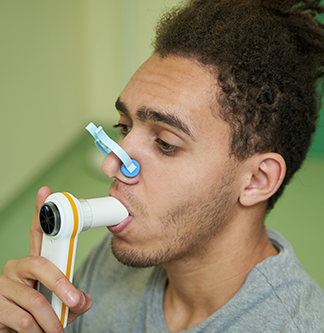
Occupational Screening Spirometry Course
An 80-hour competency course by Eduplex Training Institute and Education for Health Africa, for professionals who perform, interpret, and manage spirometry screening in occupational health settings.
Purpose
This competency course in occupational screening spirometry is hosted by Eduplex Training Institute (ETI), in collaboration with Education for Health Africa (EFHA). The course is designed for professionals who conduct spirometry screening in occupational health settings, equipping them with essential skills to perform, interpret, and manage spirometry tests competently.
The course, aligned with QCTO SP-211002, comprises theory and practical training on spirometry equipment calibration, test administration, result interpretation, reporting, and quality assurance — over an 80-hour period.

Training Available
Blended training
Online theory sessions with a one-day practical session and examination hosted in Queenswood, Pretoria, Gauteng.
Onsite training
Online pre-reading theory and a three-day onsite, in-person training in Queenswood, Pretoria, Gauteng.
Register Before
Blended learning
Register for the course by the 20th of each month.
Onsite in-person
Last registration is 3 weeks before the commencement of the workshop.
Course Dates
Blended (practical days)
Onsite
Entry Requirements
Spirometrist Practitioner
- Grade 12 / NQF Level 4 or higher
- Registration with relevant council (HPCSA / SANC / SAMA)
- Access to an occupational health clinic
Assistant Spirometrist
- Minimum: Grade 12 / NQF Level 4
- Recommended: experience in an occupational health setting and clinic access
Learning Outcomes
Spirometrist Practitioner
- Perform quality assurance and quality control tasks
- Prepare for and conduct a spirometry test
- Evaluate the validity of the test results
- Interpret the test results
- Record and report the test results
- Manage spirometry data
Assistant Spirometrist
- Perform quality assurance and quality control tasks
- Prepare for and conduct a spirometry test
- Conduct a spirometry test
- Evaluate the validity of the test results
Certification
On successful completion, participants receive a Certificate of Competence in Occupational Screening Spirometry.
Who Should Apply
This course is intended for health professionals involved in occupational health, workplace medical screenings, and respiratory function monitoring, or those who will assist Spirometrists in the occupational health clinic. Ideal for OH nurses, occupational health technicians, clinic staff, and those responsible for employee respiratory health monitoring.
How Long Will Study Take?
The overall course is 80 hours long, combining theoretical training and practical spirometry skills application — including 21 hours of workplace assignments that must be completed to pass.
Blended training
Online theory with a one-day practical session and examination in Queenswood, Pretoria, Gauteng.
Onsite training
Online pre-reading theory and a three-day onsite, in-person training in Queenswood, Pretoria, Gauteng.
FAQ
Who should apply?
Professionals responsible for respiratory health screening in occupational settings — including occupational health nurses, OH technicians, workplace clinic staff, or any individual with access to an occupational health clinic and willing to perform spirometry tests.
What qualification will I receive?
A Certificate of Competence in Occupational Screening Spirometry, enabling the holder to perform and manage spirometry testing in occupational health contexts.
What are the entry requirements?
Spirometrist Practitioner: Grade 12 / NQF Level 4 or higher; registration with relevant council (HPCSA / SANC / SAMA); access to an occupational health clinic.
Assistant Spirometrist: Minimum Grade 12 / NQF Level 4. Recommended: experience in an occupational health setting and access to an occupational health clinic.
What does the course involve?
The course comprises theory and practical training on spirometry equipment calibration, test administration, result interpretation, reporting, and quality assurance — over an 80-hour period aligned with QCTO SP-211002.